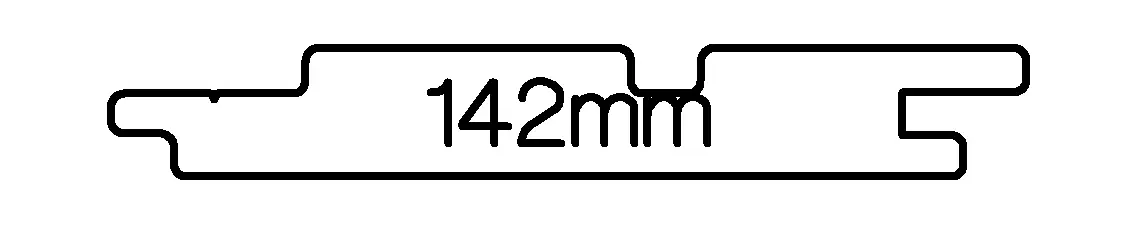
Double Secretfix
Interlocking
The boards interlock, so every board loses 20mm to the joint. Cover is the board width minus 20mm, every time.
Priced widths 117 · 138 · 140 mm
Specifying
A profile is the shape of the board's section — how it meets the board above it, whether the fixing shows, and how much of every board you actually see once the wall is up. It is the decision that changes the look most and gets thought about least.
First, the one that catches people out
Board widths are quoted as nominal sizes. Once the board is fitted, the joint hides part of it — a tongue sits inside a groove, a rebate laps under its neighbour — so the width that actually covers the wall is smaller than the width on the invoice. That figure is the cover width, and it is what every quantity should be calculated on.
On tongue-and-groove and secret-fix profiles the loss is typically around 15–25mm per board, with the exact figure set by the profile — tongue engagement scales with board width, plus a movement gap.
Open-jointed profiles work the other way round: the boards sit apart, so the gap adds to the cover rather than taking from it.
The price calculator shows the effective cover for every combination, so you never have to work this out by hand. Order at least 10% over the measured area — the industry rule of thumb, rising to about 15% for thermally modified timber, and more for diagonal fixing or a wall full of openings.
Cover-loss range and the wastage allowance are Timber Development UK guidance (BS 8605 as reproduced in the TDUK handbook), verified 2026‑07‑30. The per-combination cover figures are our own, computed from the price list.
The profiles
Not every timber offers every profile — the species page for a given timber shows what it is actually priced for, and the calculator will not let you build a combination we cannot make.
On the widths. Our standard cladding widths are 92, 117 and 142mm. The lists below show every width the price list carries for that profile, which is a longer set — it includes the narrow batten and trim sections machined to the same shape.
Interlocking
The boards interlock, so every board loses 20mm to the joint. Cover is the board width minus 20mm, every time.
Priced widths 117 · 138 · 140 mm
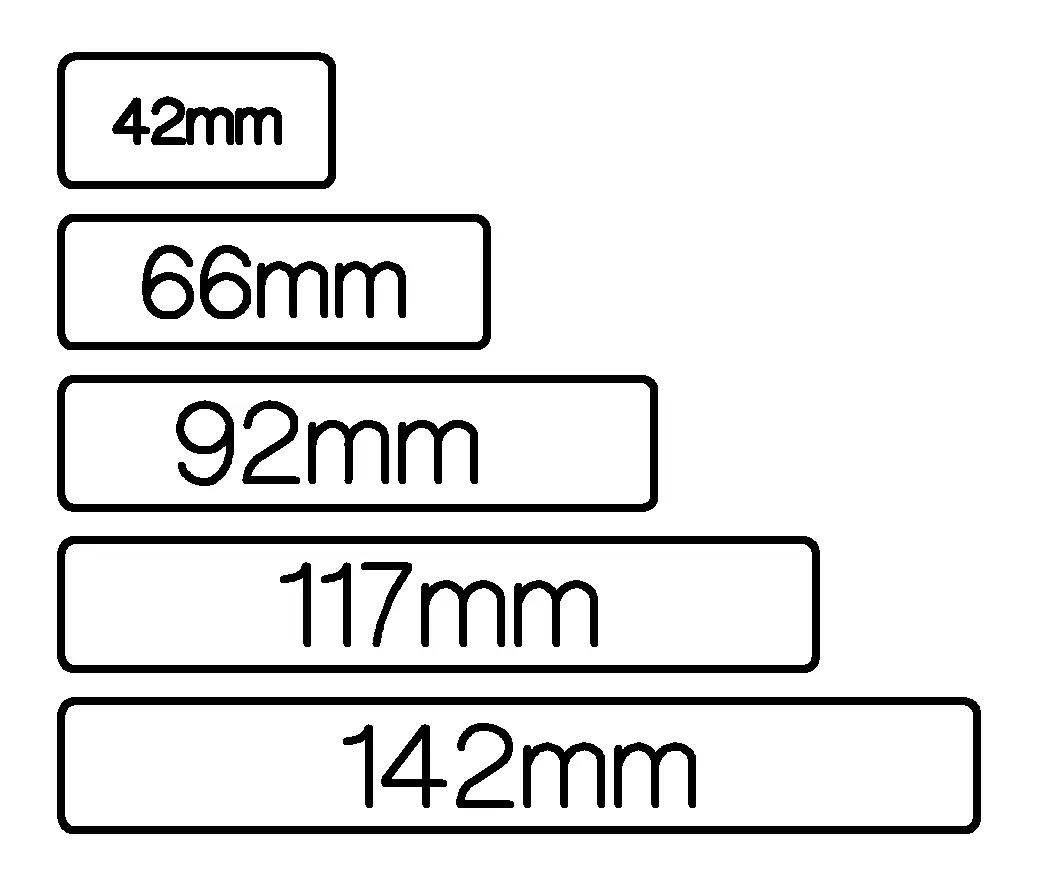
Known to us as PAR 4RA
Open joint
Square edges set apart. Cover is the board width plus the gap, and the gap is yours to choose: 3, 6, 9, 12mm, with 6mm as standard.
Priced widths 42 · 54 · 66 · 92 · 117 · 138 · 140 · 142 · 145 · 185 mm
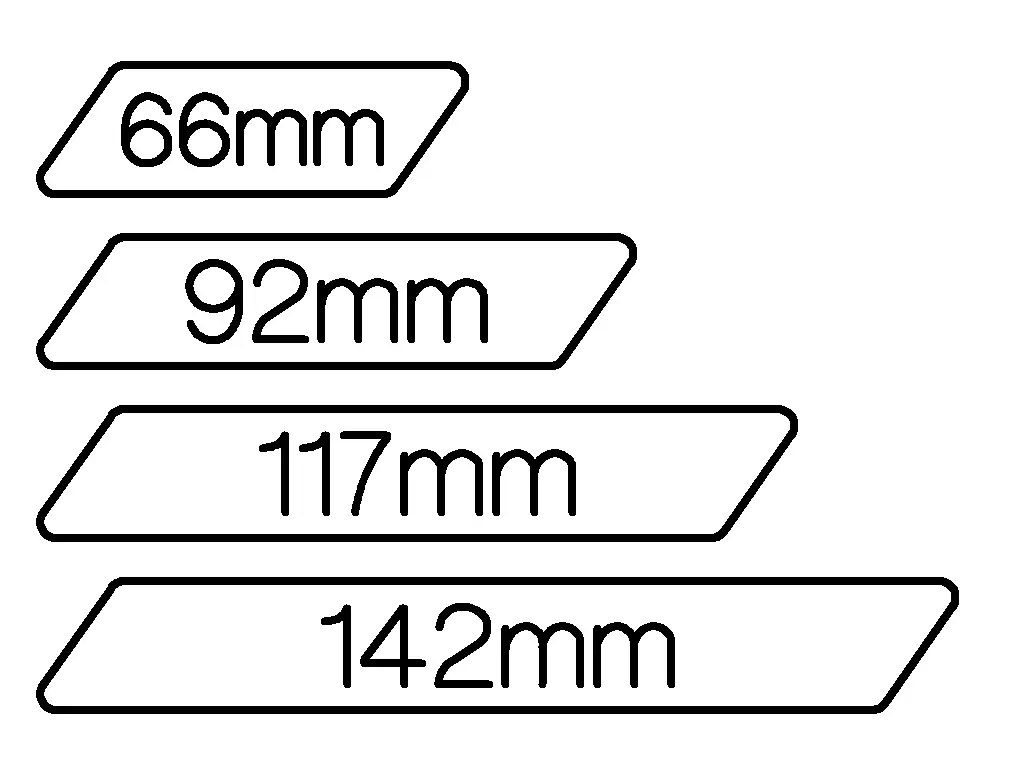
Lapped
Boards lap over one another and the lap comes off the cover. Options are 2mm lap, flush, 2mm apart, with 2mm as standard.
Priced widths 54 · 66 · 92 · 117 · 138 · 140 · 142 · 145 · 185 mm
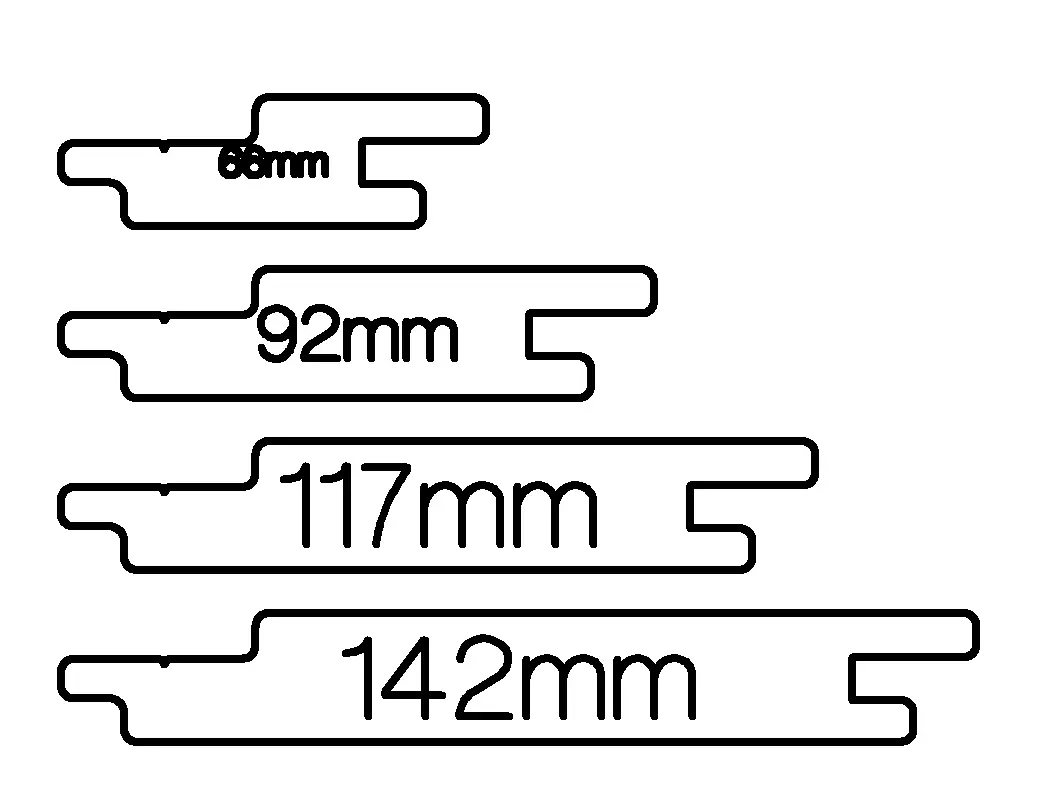
Interlocking
The boards interlock, so every board loses 20mm to the joint. Cover is the board width minus 20mm, every time.
Priced widths 54 · 66 · 92 · 117 · 138 · 140 · 142 · 145 · 185 mm
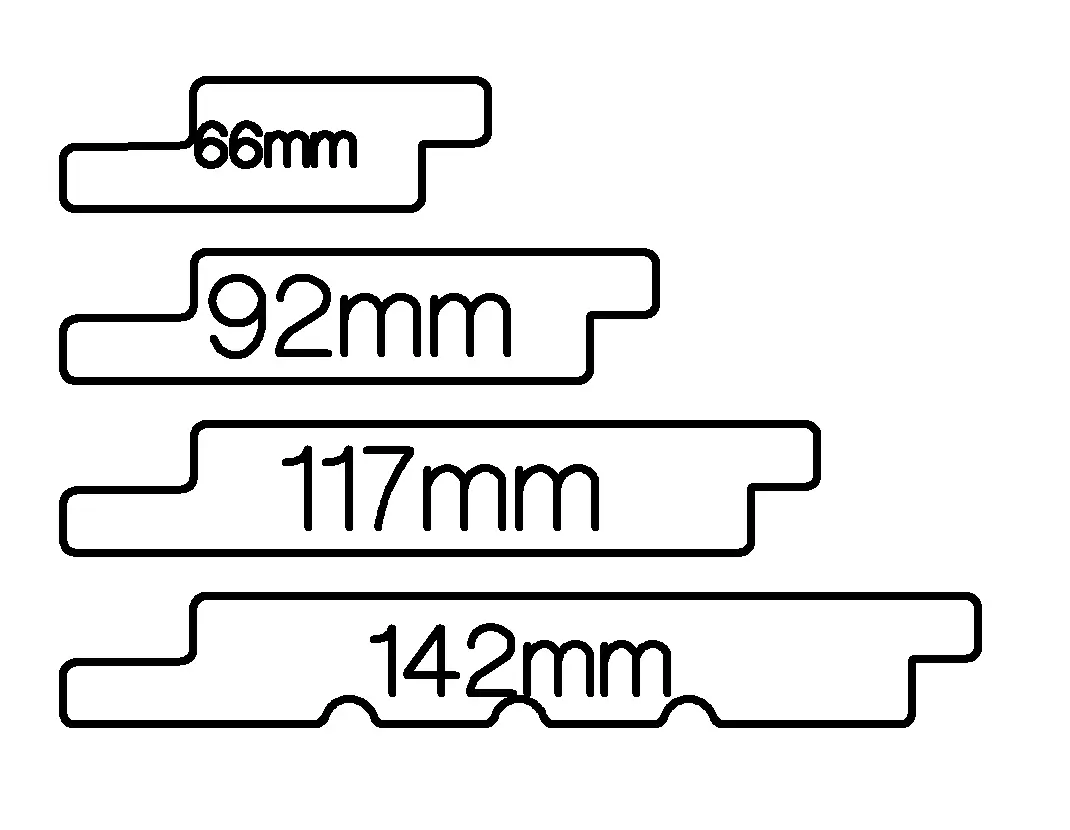
Interlocking
The boards interlock, so every board loses 10mm to the joint. Cover is the board width minus 10mm, every time.
Priced widths 54 · 66 · 92 · 117 · 138 · 140 · 142 · 145 · 185 mm
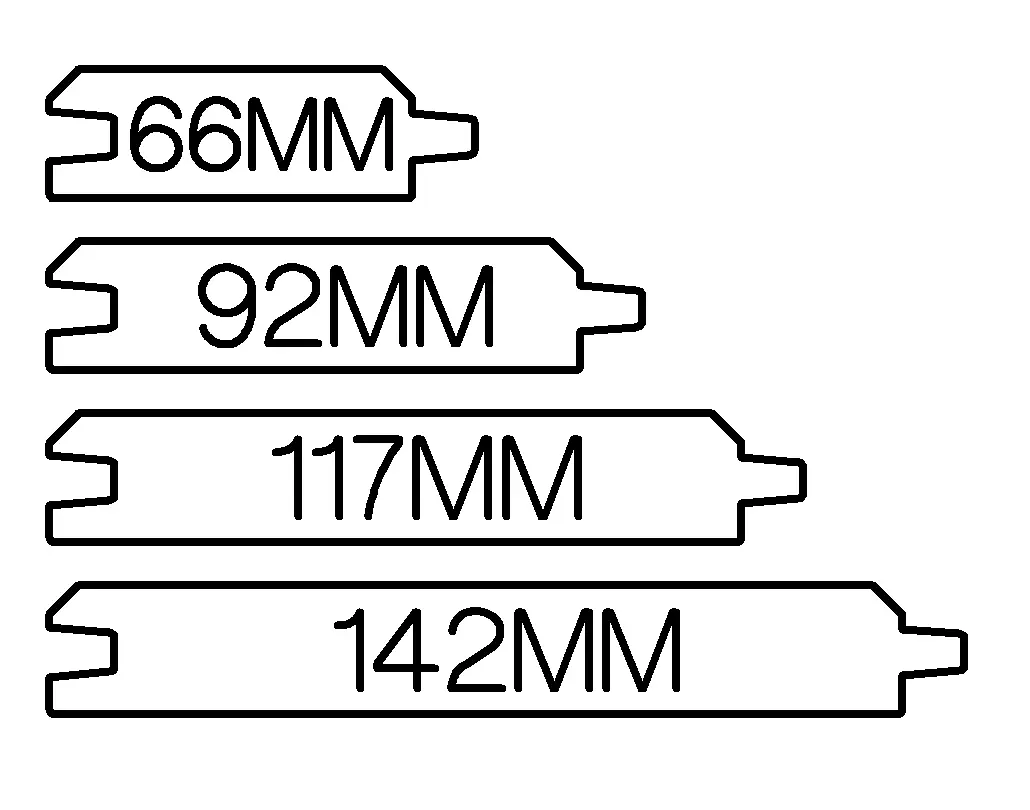
Known to us as T&GV
Interlocking
The boards interlock, so every board loses 10mm to the joint. Cover is the board width minus 10mm, every time.
Priced widths 42 · 54 · 66 · 92 · 117 · 138 · 140 · 142 · 145 · 185 mm
Open joint
Square edges set apart. Cover is the board width plus the gap, and the gap is yours to choose: 3, 6, 9, 12mm, with 6mm as standard.
Priced widths 42 · 47 · 54 · 66 · 73 · 92 · 100 · 117 · 140 · 142 · 145 · 150 · 185 · 200 mm
Interlocking
The boards interlock, so every board loses 7mm to the joint. Cover is the board width minus 7mm, every time.
Priced widths 54 · 66 · 92 · 117 · 138 · 140 · 142 · 145 mm
Interlocking
The boards interlock, so every board loses 10mm to the joint. Cover is the board width minus 10mm, every time.
Priced widths 140 · 145 · 185 mm
Interlocking
The boards interlock, so every board loses 10mm to the joint. Cover is the board width minus 10mm, every time.
Priced widths 117 · 138 · 140 · 142 · 145 mm
Known to us as PAR 4RA Board on Board
Lapped
Boards lap over one another and the lap comes off the cover. Options are 20mm lap, 25mm lap, 30mm lap, with 25mm as standard.
Priced widths 54 · 66 · 92 · 117 · 138 · 140 · 142 · 145 · 185 mm
Known to us as Fine Bandsawn Board On Board
Lapped
Boards lap over one another and the lap comes off the cover. Options are 20mm lap, 25mm lap, 30mm lap, with 25mm as standard.
Priced widths 42 · 47 · 54 · 66 · 73 · 92 · 100 · 117 · 140 · 142 · 145 · 150 · 185 · 200 mm
6 of these have no section drawing yet
We have drawings for 6 of the 12. The rest are made and priced exactly like the others — the drawing simply has not been produced. Rather than show you a picture of a different profile, we have left the box empty and said so. If you are specifying one of them, email us and we will send the section, or come and look at a machined board at the mill.
We machine to a drawing. If the profile you need is not one of the above, send it over — it is a normal thing to ask a mill, not a special favour. A custom profile is priced per job rather than off the list.
How it is held on
Two ways to attach a board to a batten, and the profile you choose largely decides which one you are having.
Nails or screws driven through the face of the board into the batten, finished flush and never punched below the surface. Timber Development UK and the TDCA call it the most secure way to install timber cladding.
Screwed through the tongue of a tongue-and-groove profile, or clipped, or fixed from behind — so the finished face carries no visible fastener. It suits dimensionally stable timbers.
TDUK, TDCA and Abodo installation guidance, verified 2026‑07‑30. Screw sizes, stainless grades and pre-drilling are on the counter battens page.
Open joints and shadow gaps
What we machine. Our square-edge profiles — Planed All Round and Fine Bandsawn — are set apart at 3, 6, 9 or 12mm, with 6mm as standard. Rainscreen runs a 2mm lap, flush, or 2mm apart. Those are the gaps the price list carries and the calculator prices.
What the industry says about a true open joint. TDUK and the TDCA put open-jointed and shadow-gap cladding at 8–15mm between boards, with 8–10mm the commonest machined choice, over a UV-resistant breather membrane. Too big and the wall build-up behind starts to show; gap choice also has to account for board width and how much the species moves.
Those two paragraphs are answering different questions, and we have deliberately not blended them into one number. A narrow machined gap is a shadow line on a closed build-up. A genuine open-jointed rainscreen — where the joint is part of how the wall drains and ventilates — is a design decision for your building professional, and the membrane behind it is not optional.
Industry figures: TDUK and TDCA guidance on open-jointed cladding, verified 2026‑07‑30. Our machined gap options come from the 2026 price list.
Samples are free and posted on request — name the profile as well as the species and we will send that shape, not a flat offcut.
Tiny Tony AI assistant
Instant answers 24/7 · humans reply Mon–Fri, 9–5